
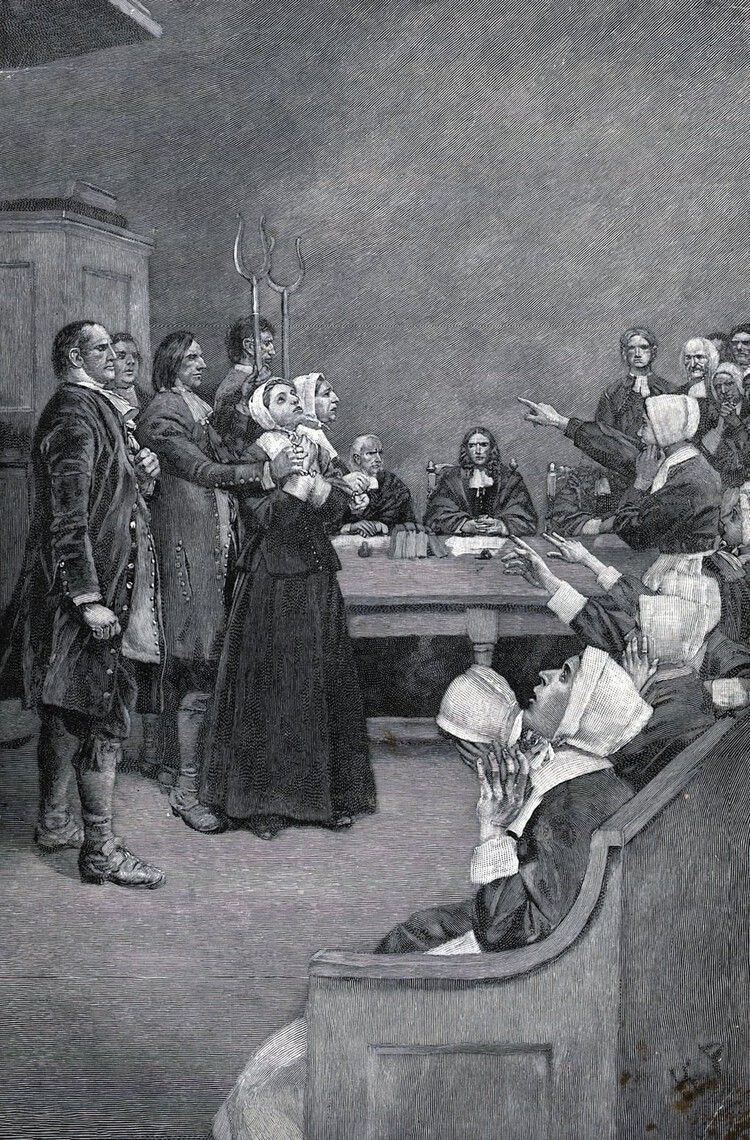
When most people hear the words Salem Witch Trials, they picture witches, curses and dark magic.
The reality is far more disturbing.
Because despite the name, there were never any witches.
Instead, the Salem Witch Trials became one of history’s most infamous examples of fear, paranoia and mass hysteria spiralling completely out of control.
Where Did It All Begin?
The story begins in 1692 in Salem Village, Massachusetts, a small Puritan settlement in colonial America.
Life in Salem was already difficult.
The community was deeply religious, and many people genuinely believed that the Devil was constantly working to corrupt humanity. Illness, crop failures and unexplained misfortune were often viewed through a religious lens. If something bad happened, people frequently searched for a supernatural explanation.
It was a world where belief in witchcraft wasn’t unusual.
It was considered completely real.
The panic began when two young girls, Betty Parris and Abigail Williams, started behaving strangely.
Witnesses described them screaming, making unusual noises, crawling beneath furniture and suffering violent fits. Local doctors were unable to find a physical explanation for their behaviour.
Eventually, one doctor suggested something that would change Salem forever.
The girls, he claimed, might be suffering from witchcraft.
The First Accusations
Once the idea of witchcraft entered the conversation, events escalated frighteningly quickly.
The girls were pressured to identify who might be responsible.
Soon, fingers began to point.
The first people accused were women who already existed on the edges of society.
One was Tituba, an enslaved woman living in the Parris household. Another was Sarah Good, a homeless beggar. The third was Sarah Osborne, an elderly woman who had become unpopular within the community.
In many ways, these women were easy targets.
They were vulnerable. Different. Already viewed with suspicion.
As accusations spread, the panic grew.
How Fear Took Over Salem
This is where the story becomes particularly disturbing.
The accusations didn’t stop with social outcasts. They spread.
Neighbours accused neighbours.
Children accused adults.
Friends accused friends.
Even respected members of the community found themselves under suspicion.
One accusation often led to another. Some people accused others in an attempt to protect themselves. Others genuinely believed they were fighting evil.
The result was a terrifying atmosphere where almost anyone could suddenly find themselves accused. And once accused, proving your innocence became nearly impossible.
The “Evidence”
One of the strangest aspects of the Salem Witch Trials was the type of evidence that was accepted.
Today, courts rely on physical evidence, witnesses and established legal procedures. Salem was different.
One of the most controversial forms of evidence was known as spectral evidence. This involved people claiming that they had seen a person’s spirit tormenting them.
Think about that for a moment. Someone could stand in court and say:
“I saw their ghost hurting me.”
And that statement could be treated as evidence. The accused often had no meaningful way to defend themselves against such claims.
How do you prove you didn’t send your spirit to attack somebody?
You can’t.
The system was fundamentally flawed from the beginning.
The Executions
As the panic intensified, arrests increased. Jails became crowded. Trials continued.
Eventually, executions began.
Nineteen people were hanged after being convicted of witchcraft.
One man, Giles Corey, refused to enter a plea during his trial. Rather than hanging him, authorities subjected him to a punishment known as pressing. Heavy stones were placed upon his body in an attempt to force him to speak.
The weight gradually crushed him to death. According to legend, his final words were simply:
“More weight.”
By the time the hysteria ended, dozens of people had been imprisoned and twenty individuals had lost their lives.
None of them were witches.
Why Did It Happen?
This is the question historians have been asking for centuries.
There isn’t one simple answer.
Several factors likely contributed.
Religious extremism played a role. The Puritan community genuinely believed in the existence of witches and the Devil.
Fear and uncertainty also mattered. Salem was experiencing political tensions, economic difficulties and conflicts with nearby Indigenous groups. Anxiety was already high before the accusations began.
Personal grudges may have contributed as well. Some accusations conveniently targeted rivals, enemies or unpopular members of the community.
And perhaps most importantly, fear became contagious.
Once people became convinced that witches were hiding among them, every unusual event seemed to confirm that belief.
Panic fed panic. Accusation fed accusation. Until the situation became impossible to control.
How Did It End?
Eventually, cracks began to appear. More and more people started questioning the trials and the evidence being used. When accusations began reaching highly respected members of society, even supporters of the trials grew uneasy.
Public opinion shifted. Authorities gradually stopped accepting spectral evidence. Trials slowed. Prisoners were released.
The hysteria finally came to an end.
In later years, many people involved expressed regret for their actions. The Massachusetts government eventually acknowledged that mistakes had been made and worked to clear the names of many victims.
But by then, the damage had already been done.
Why Are We Still Talking About Salem?
The Salem Witch Trials remain fascinating because they reveal something uncomfortable about human nature. It’s easy to imagine ourselves behaving rationally in moments of fear.
History suggests otherwise.
The people of Salem weren’t monsters. They were ordinary people who became convinced they were doing the right thing. That’s what makes the story so unsettling.
The real horror isn’t witchcraft. It’s how quickly suspicion can replace reason. How easily fear can spread through a community. And how dangerous it becomes when people stop questioning what they’re told.
More than three centuries later, the Salem Witch Trials remain a warning about the power of panic, misinformation and mass hysteria.
 The Everything Journal
Leave a comment